
Kern County City Directory Collections
The verified Kern shelf begins with L. L. Paulson's regional directory or handbook from 1875 and continues through local Bakersfield directories, telephone books, and reverse address volumes. Beale Memorial Library holds Bakersfield city directories from 1899 forward, although the library has not published a complete volume-by-volume publisher or final-year list. The Library of Congress supplies free page images for many telephone books and keeps paper-slip access for the criss-cross runs. The digitized Paulson item is the earliest verified online anchor.
| Collection | Years | Where Held | Access |
|---|---|---|---|
| Paulson regional directory or handbook | 1875 | Library of Congress digitized item | Free online scan |
| Bakersfield city directories | 1899 forward; gaps and final year unstated | Beale Local History Room | In person; noncirculating |
| Kern telephone directories | 1940 forward locally | Beale Local History Room | Call ahead; in person |
| Kern white and yellow telephone books | October 1934 through April 1963, with listed gaps | Library of Congress page images | Free online images |
| Bakersfield, Lamont, and Oildale criss-cross | 1954 to 1990 | Library of Congress | In-person paper-slip request |
| Nine-community criss-cross run | 1962 to 1990 | Library of Congress | In-person paper-slip request |
The year ranges are not a claim that every year survives in every format. The library has not published the exact gaps, publishers, or last printed Bakersfield volume. A missing year may require a telephone book, newspaper, yearbook, census schedule, museum collection, or archive inventory instead of a direct shelf search.
Beale's Kern County City Directory Shelf
Jack Maguire Local History Room at Beale Memorial Library is the core local repository. It sits on the second floor at 701 Truxtun Avenue in Bakersfield. The room is noncirculating, and staff availability affects opening and research help, so call 661-868-0771 before making the trip. A call ahead can also let staff stage a requested year or microfilm, which is especially useful when the target community is not central Bakersfield.
The local shelf extends beyond names and addresses. Holdings include books, pamphlets, newsletters, vault material, and vertical files on more than 900 subjects. Bakersfield directories start in 1899, Kern telephone directories start in 1940, yearbooks are mainly from the 1960s and 1970s, and some primary sources reach into the 1800s. The Beale Genealogy Room information adds printed vital records, family-name and heraldry works, California census microfilm through 1920, and the Sutro microfiche index.
The Beale collection page shown here is the correct lead-in before an in-person shelf visit.
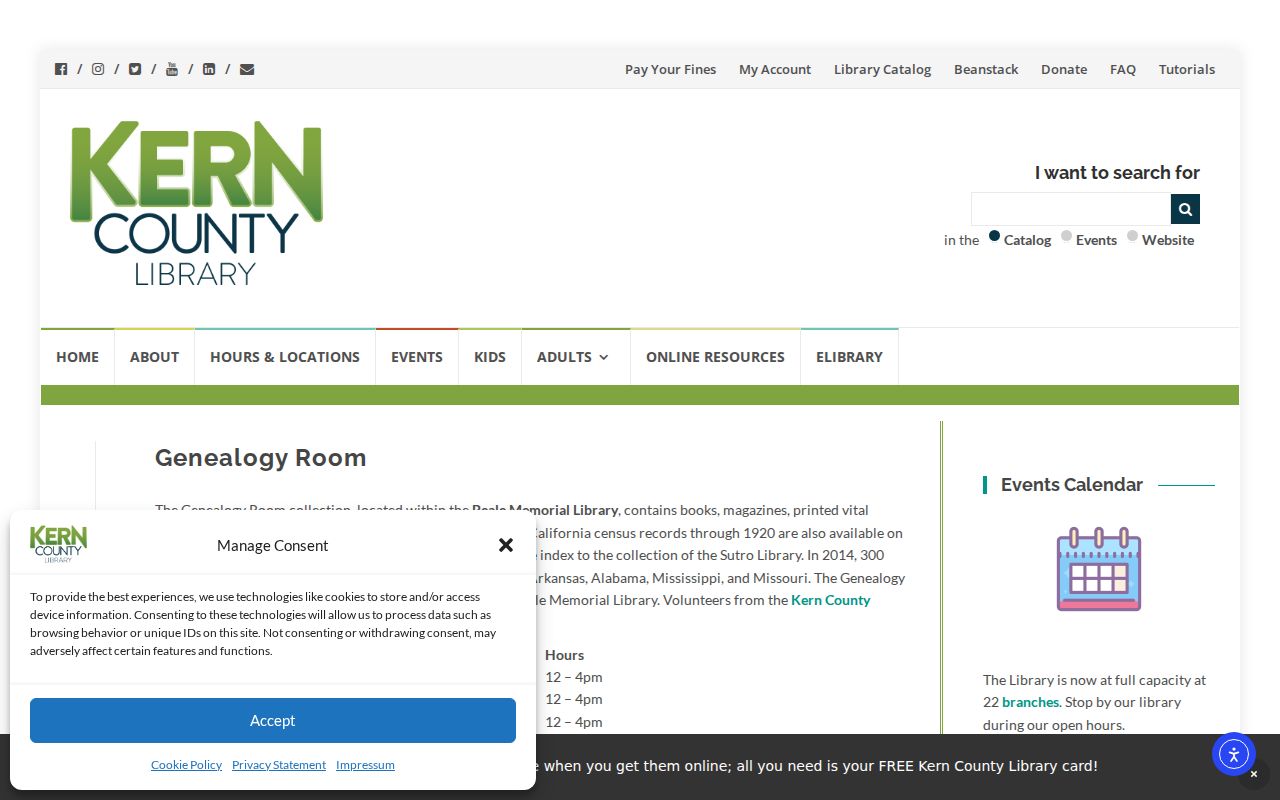
The image points to a practical rule for the city directory shelf: ask for a year, community, and record type, then note the call number and page while the volume is available.
Kern County Telephone Books and LOC Pages
Telephone coverage is more detailed than a single start date suggests. The Library of Congress lists white and yellow pages for October 1934 through November 1939; August 1940 through June 1944; March 1945 through September 1946; July 1947 through September 1949; June 1950 through June 1951; June 1952 through June 1953; June 1954 through June 1955; April 1956, 1957, and 1958; and April 1959, 1960, 1961, 1962, and 1963. Beale's local shelf begins at 1940, while the online scans make older pages available for image-based work. The Library of Congress page viewer shows how a scanned Kern telephone entry should be read against its printed page.
The library's research resources also include a NewspaperArchive license with more than 100 million searchable pages. Local Bakersfield newspaper coverage reaches back to 1875 in digitized Bakersfield Californian material, with limited 2013 to 2017 coverage and microfilm from 1978 to the present. Shafter Press, Shafter Progress, and other local titles can fill a gap when a name is absent from a directory.
The Kern County Library research-resources page shown here identifies the online tools that complement the physical shelf.
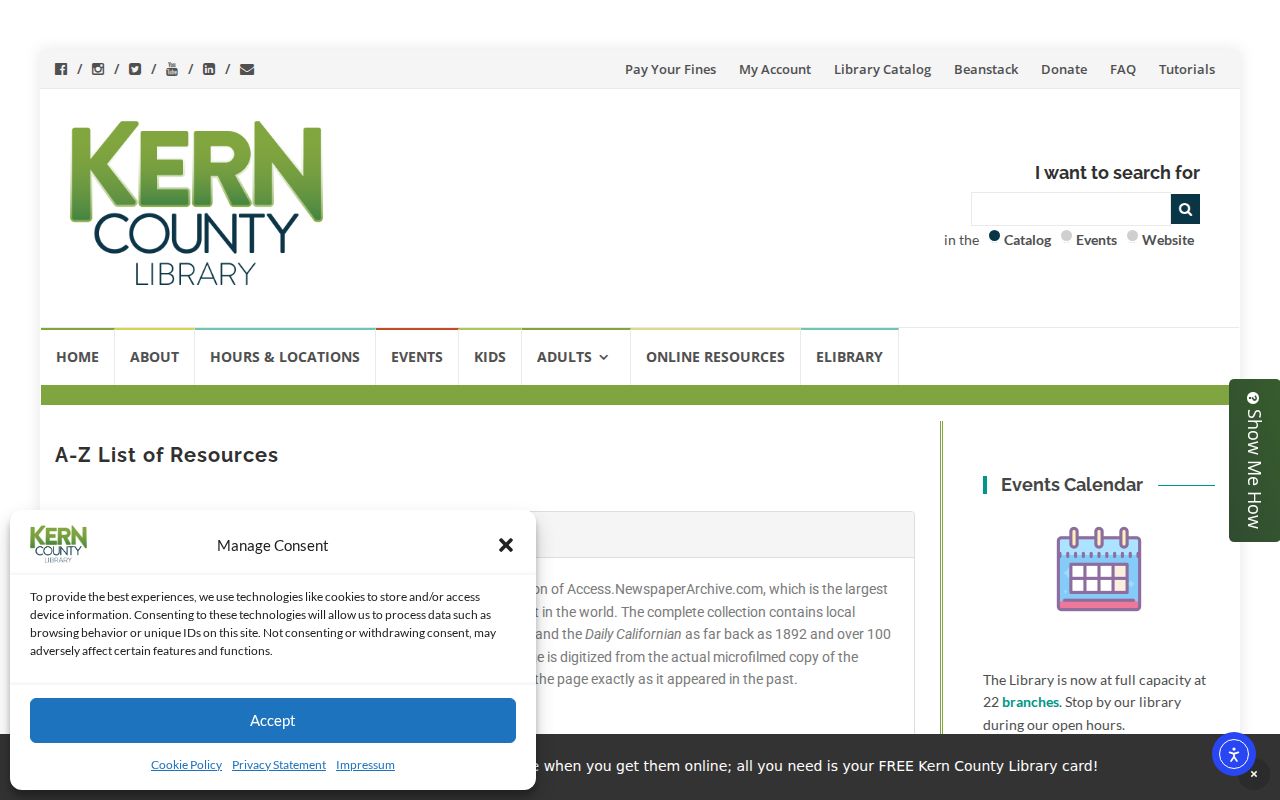
Online images are a starting point, not a substitute for the page key. Record the volume, page, community, and image URL so a later reader can repeat the search.
Kern County Community Codes in 1959
The inspected 1959 Kern telephone directory interfiles communities inside one alphabetical run. The legend says that no community code means Bakersfield, L means Lamont, and O means Oildale. A small letter can therefore change the locality attached to a name. The street abbreviation, exchange, and telephone line add more context, but they still describe a subscriber listing rather than every person at an address.
Searchers should photograph or transcribe the legend before reading the entries. The same surname may occur in several communities, and a street name may not be unique across the run. Use the code, street number, exchange, and page together. If an entry seems out of place, check the page image and an adjacent year rather than correcting the book from modern geography.
The 1959 sample also shows why a Kern County volume can be both useful and easy to misread. Business and residential listings coexist. “See also” references redirect a name. OCR can turn an exchange or abbreviation into a false name. A community code is a clue to record geography, not proof of a person's full residence history.
Reading a Kern County City Directory Entry
A city directory entry should be read field by field. The inspected 1959 telephone sample shows a surname with a given name or initials, occasional honorific or status, a street number with an abbreviated street, an exchange and telephone, and occasional occupation or business information. True city directories may carry other household notation, but the exact marks must be learned from the volume's own key.
Do not fill an unprinted field with an assumption. A spouse, widow notation, owner mark, or occupant mark may appear in a particular volume and may be absent from a telephone book. The table distinguishes what the sample supports from what needs confirmation in the actual book.
| Name | Surname with given name or initials; an honorific or status may appear. |
|---|---|
| Occupation or business | Occasional occupation or business text; the sample included an OCR reading of “watch repr.” |
| Address | House number and abbreviated street, often paired with exchange and telephone. |
| Spouse or status | Volume-specific. Confirm any spouse, widow, or status notation in the printed page. |
| Owner or occupant mark | Not confirmed in the inspected 1959 telephone sample; check the directory key before assigning meaning. |
- Criss-cross directory
- An address-ordered volume. Find the street and number first, then read the listed name or business.
- Householder index
- A name-ordered finding aid for heads of household or listed residents when a volume provides one.
- Abbreviation key
- The volume's explanation of street, exchange, status, community, or business marks. Photograph it before transcribing entries.
The exact publisher and page design matter. The research gap is real: Beale has not published a complete publisher-by-publisher shelf inventory, and the verified free sample is a telephone page rather than a confirmed Polk page.
OCR Cautions for Kern County Directory Pages
Optical character recognition, or OCR, makes a scanned page searchable by turning printed shapes into text. It can also fuse initials, drop spaces, misread abbreviations, interpret exchange letters as names, or lose a community code. An OCR hit is therefore a lead to a page, not the final transcription.
Read the image at full size and keep two notes when a word is uncertain: the machine reading and the image-based reading. Copy the page number, street spelling, community code, and adjacent heading. A page image can resolve whether a mark belongs to a surname, a business, a telephone exchange, or a local abbreviation.
Call-ahead tip. Give Beale staff the person's name, likely community, approximate year, and record type. Staff can stage microfilm or point to a better local title before the visit.
Newspaper and obituary request forms are useful when the directory trail stops. Provide a narrow date, locality, and known relative so the library can search a defined question rather than an open-ended name.
Kern County Directory Research Timeline
Kern's historical sequence is a set of overlapping collections rather than a single uninterrupted publication. The dates below are verified collection anchors. They show when to switch from a regional handbook to local shelves, telephone images, reverse address books, maps, or archive inventories.
- 1875: L. L. Paulson's regional directory or handbook supplies the earliest verified digitized directory item.
- January 1890: Four Bakersfield Sanborn sheets provide built-environment evidence for streets, footprints, uses, and configuration.
- 1899 forward: Beale's Bakersfield city-directory sequence begins, with exact gaps and final year not published.
- 1934 to 1963: Library of Congress telephone books provide the verified online image sequence with listed gaps.
- 1954 to 1990: Bakersfield, Lamont, and Oildale criss-cross volumes support address-first research.
- 1962 to 1990: The broader nine-community criss-cross run adds rural, mountain, desert, and smaller city coverage.
The Sanborn map dates a built environment, not a person. The directory dates a listing, not necessarily a move-in date. The January 1890 Bakersfield Sanborn item is a map reference, not an occupant roll. For a complete historical claim, pair the collection date with the page, address, census timing, and a second source.
Trace Kern County Households Through Directories
Genealogy work is strongest when a name and address move together. Start with the first appearance you can prove, then follow the same spelling, initials, community code, occupation, and street line across nearby years. The 1900 through 1950 federal census schedules are currently public, while the 72-year rule means the 1960 schedules open in 2032. A directory year may fall before or after the April census date, so it should locate a question rather than replace the census household record.
- Find the person's first likely appearance and copy the page image, name, address, status, and community mark.
- Check the next available year, watching for initials, spouse or widow notation, occupation changes, and street moves.
- Flip to the criss-cross section for the known address and scan adjacent house numbers and cross streets.
- Pair the directory date with a public census schedule, newspaper item, yearbook, obituary, or probate clue.
- Mark a disappearance as unresolved until adjacent years and another source distinguish a move, death, unlisted line, or coverage gap.
A woman may be listed under her own given name, a spouse's initials, or a “Mrs.” form. A business may be indexed under its trading name or proprietor. These conventions must be checked in the specific volume used, especially when an entry is being used to connect relatives.
For the modern address-keyed record trail, use the Kern County street directory workflow after the historical entry has supplied a parcel or street clue.
Kern County Archives Beyond the Directory Shelf
The WPA Inventory of the County Archives of California, Kern County records the series that a historical survey found in local custody. It is a vocabulary and lead sheet, not proof that every series remains online. The Kern County Museum Research Center holds manuscripts, photographs, maps, and ephemera by appointment. Its Bakersfield Californian Foundation Research Center can be reached at Archivist@kerncountymuseum.org.
The CSUB Historical Research Center has more than 200 oral histories covering Dust Bowl migrants, Kern “Rosies,” Bakersfield Sound, and regional communities. The Kern County Genealogical Society, founded in 1964, assists with research and integrated its collection with the library under a 1981 agreement. Obituary and article request forms offer a written route for remote researchers, while the museum, CSUB, and other archives use appointments and finding aids.
The Kern County Museum collections page shown here marks the archive route for photographs, maps, manuscripts, and ephemera that a directory may never include.
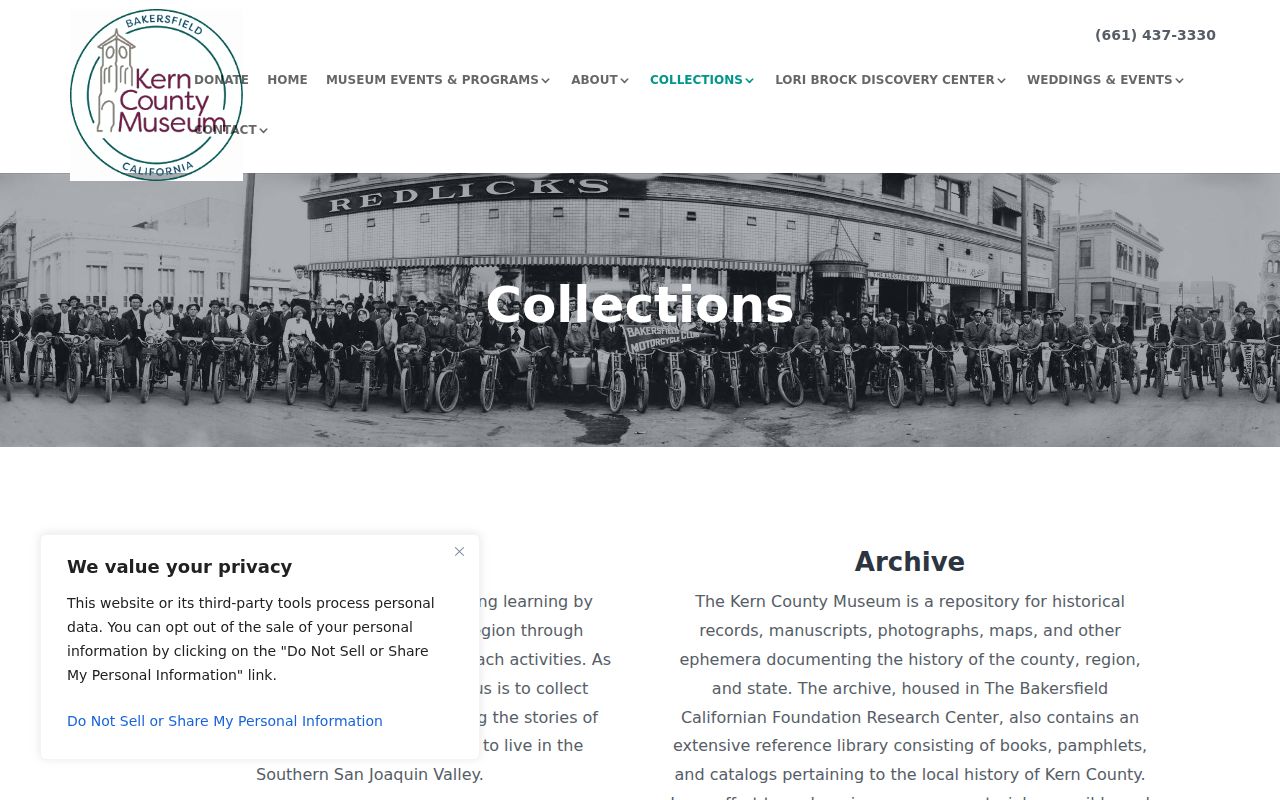
When a public agency record is identifiable but not exposed online, a CPRA request may be appropriate under Government Code §§7920.000 et seq. It cannot force a library, museum, or archive to create a new directory, and it does not replace the custodian's own access rules.